In the first two posts of this series, we explored what it means for a nation to be great from an eternal perspective. We examined the template that God gave his most favored nation (Israel) on how to reflect his divine character by treating three specific classes of individuals (widows, orphans and aliens) with special care. God directly tied the wellbeing of the nation to its treatment of these protected classes, and warned against their mistreatment upon threat of a violent curse from the almighty. Treating these protected classes well, and with special emphasis on aliens, means acting justly towards them, feeding them, clothing them, relating to them them as native-born, and loving them with affection as we would love ourselves.
Jesus took this a step further when he described his task on judgement day, to divide peoples between the sheep and the goat. The sheep were those who took care of the protected classes (widows, orphans, aliens), and in doing so, took care of Jesus himself. Goats were those who neglected or mistreated the protected classes… and in doing so, neglected and mistreated Jesus himself. Jesus so identified with the protected classes that any service given to them was giving service to Jesus himself, and any neglect toward them was neglecting Jesus himself.
Why would the creator of the universe single out these three protected classes for special care and treatment? Why would God condition the welfare of these classes as the measure of greatness for a nation?
If we could come to understand why these protected classes are so near and dear to God’s heart, it might transform our approach to caring, advocating, and protecting them from a task to accomplish, to an outpouring of character that reflects God’s heart.
There are multiple layers behind God’s imperative for his people to treat the widows, orphans, and strangers (aliens) among them with extra special care and attention.
Recall that God mentions a reason why his own people should treat aliens and strangers (ger in the original Hebrew language) well:
Exodus 22:21 Do not mistreat an alien (ger) or oppress him, for you were aliens (ger) in Egypt (mitzraim).
Leviticus 19:34: “The alien (ger) living with you must be treated as one of your native-born. Love him as yourself, for you were aliens in Egypt (mitzraim). I am the LORD your God.
In these two examples, God draws the direct connection to God’s people having been aliens and strangers in their own history.
Many of us are probably familiar with the Bible story of the Israelites being slaves in Egypt, and God raising Moses to lead them out slavery and toward a new homeland (Thanks to Disney’s The Prince of Egypt). The Jewish celebration of Passover (pesach) commemorates this salvation from bondage and release from misery. While in Egypt, the Israelites were aliens and strangers and subjugated under harsh treatment.
The Hebrew word that is translated in the Bible as Egypt is “mitzraim”, which itself is the plural form of the root mesar which means “trouble, distress, pain, and being in dire straits”. Some scholars link the Hebrew root mesar to the Arabic name for Egypt, misr. They are practically homonyms. One wonders then, if it is a coincidence, that the English word, misery, comes from the Latin word miseria, which comes from the root miser, which means “wretched” but also sounds quite close to the Egyptian misr, and the Hebrew mesar.
So the passages about aliens and how God’s people were once aliens in mitzraim can be read from a specific historical event – of their forefathers having lived in exile in Egypt, but also as a generalization that the people of God have experienced misery themselves. They have been in dire straits before.
God is calling on his people to demonstrate empathy and compassion to the alien (ger) among them since they themselves know what it feels like to live in misery.
There is another layer to this that goes deeper and farther back than the Israelites having been aliens themselves in Egypt and experiencing misery.
The founding patriarch of the Jewish people, Abraham, was himself an alien. At a time when the Bible records humanity gravitating towards cities and assembling to build monuments to human achievement and technological advancement such as with the Tower of Babel, the Biblical narrative singles out one family who sets out from Ur, the regional center of culture in what is now southern Iraq leaving behind civilization and heading northwest toward the land of Canaan.
Genesis 12:1 God to Abram: “Leave your country, your people, and your father’s household and go to the land I will show you.”
The very first thing we are told about Abram (who later gets renamed Abraham) is that he obeys God’s call to leave what is familiar and a source of security (his extended family and “home” culture) and willingly embarks on an adventure into the unknown. Until God established a homeland for his descendants, Abraham and his offspring would be strangers and aliens wandering after the voice of God in various lands that were not their ancestral homes. Abraham himself would eventually spend some time in Egypt (mitzraim) as did his grandson, Jacob, who had a similar foray into Egypt as an alien. God also confirms to Abraham that his descendants would also be wanderers and strangers in a foreign land…. something that came true with his great-grand son Joseph and the generations after him.
Genesis 15:13 God to Abram: “Know for certain that your descendants will be strangers (ger) in a country not their own….”
The very birth of the nation of Israel through its founding forefather was accomplished through an act of obedience by Abram to become an alien/stranger (ger) by leaving his family and culture. Israel would not have come into being had not Abraham chosen the path of alienation from familiarity, safety, and predictability.
As remarkable an origin story this represents, this was not the first time the Bible spoke about a main character leaving home and becoming an alien.
That distinction goes to the story of Adam and Even who were themselves banished from the Garden of Eden. Eden was their original home, the place where they communed with God through daily walks. After their indiscretion with eating fruit from the Tree of the knowledge of good and evil (a symbol of their desire of independence and obtaining their treasure apart from God’s presence), Adam and Eve (and their descendants) were banished from the garden and forced to leave their “home” and become aliens living in exile for the rest of their lives.
Exodus 3:23 So the LORD God banished him from the Garden of Eden to work the ground from which he had been taken. 24 After he drove the man out, he placed on the east side of the Garden of Eden cherubim and a flaming sword flashing back and forth to guard the way to the tree of life.
Not only is the nation of Israel and its founding patriarch intimately intertwined with feelings of alienation, but this theme runs back to the beginning of mankind itself. In the Biblical narrative, all of humanity became aliens after Adam and Eve’s expulsion from the Garden of Eden. Their choice of independence (in taking and eating from the Tree of Knowledge of Good and Evil apart from God’s presence) resulted in them losing their “home” of proximity with God and daily walks in the garden.
Indeed, this concept is reiterated in Psalm 119:
verse 19 “ I am a stranger (ger) on earth; do not hide your commands from me.”
The Psalmist is identifying themselves (or all of God’s people) as an alien/stranger (ger), the same word used in Exodus 22:21 and Leviticus 19:34 and translated as “alien”
Exodus 22:21 can therefore be translated,
“Do not mistreat an alien/stranger or oppress him, for you yourselves were aliens/strangers in distress.
Leviticus 19:34 can also be translated,
“The stranger/alien living with you must be treated as one of your native-born. Love him/her as yourself, for you were stranger/alien in distress. I am the Lord your God.”
If God understands all of humanity as being estranged from him (cast out from the garden abode of Eden) and wishes for them to be cared for and nurtured even in their estrangement, this imperative for God’s people to treat the strangers/aliens among them well – with generosity and love – is a reflection of God’s compassion for those who have wandered from communion with him. God’s heart of compassion for the lonely, downtrodden, distressed flows not just for his own people, his own favored nation, but to all people and all nations including the aliens and strangers living among God’s people. When God calls his people to treat the alien/strangers among them well, he is compelling them to take on the same mantle that God wears for the poor, the afflicted, and the distressed.
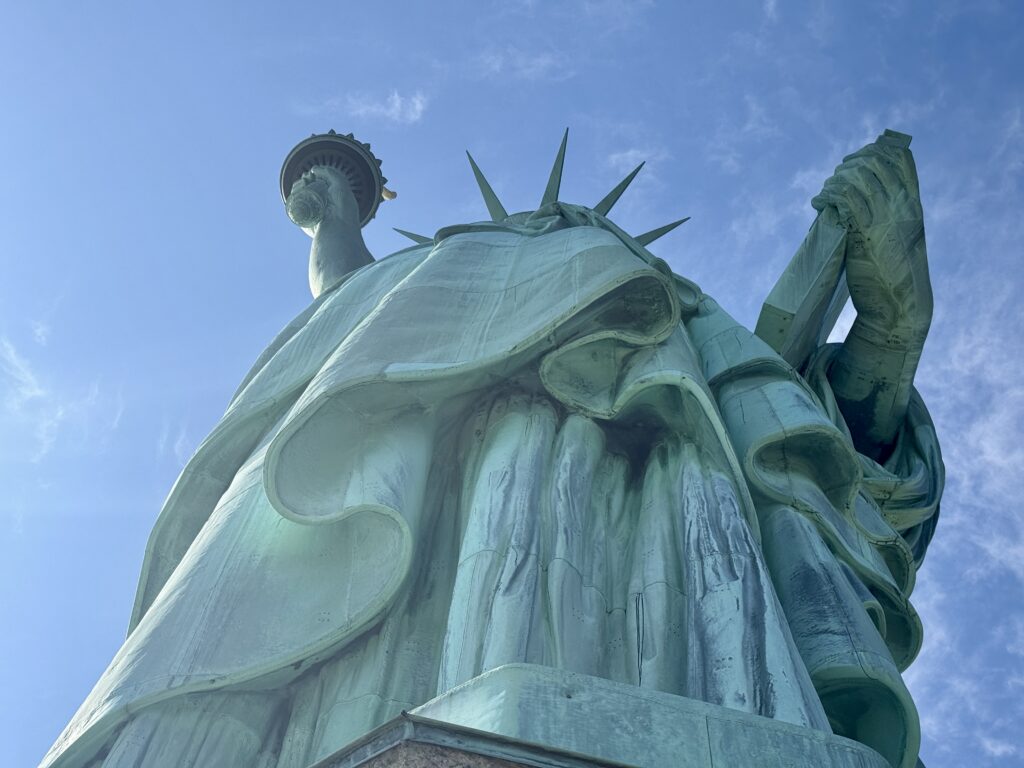
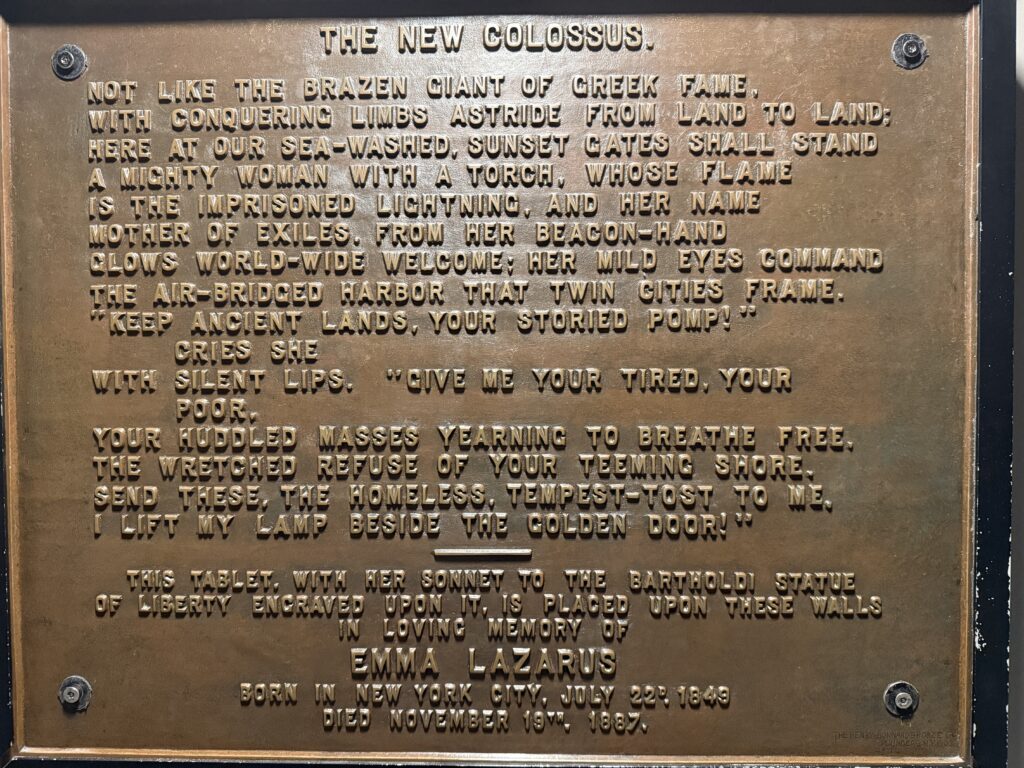
There is a plaque affixed to the base of the Statue of Liberty in New York harbor that reflects this very ethos. The poem inscribed on this plaque, The New Colossus, was written by Emma Lazarus, and captures the very essence of this attitude and value for the alien/stranger and a country’s eager willingness to embrace and welcome them to its shores. It contrasts Lady Liberty (Mother of Exiles) with the ancient world wonder monuments of old (Colossus) which glorified conquest through power.
The New Colossus
Not like the brazen giant of Greek fame, with conquering limbs astride from land to land;
Here at our sea-washed, sunset gates shall stand, a mighty woman with a torch,
Whose flame is the imprisoned lightning, and her name Mother of Exiles.
From her beacon-hand glows world-wide welcome;
Her mild eyes command the air-bridged harbor that twin cities frame.
“Keep, ancient lands, your storied pomp!” cries she with silent lips;
“Give me your tired, your poor, your huddled masses yearning to breathe free,
The wretched refuse of your teeming shore – send these, the homeless, tempest-tost to me,
I lift my lamp beside the golden door!”
– Emma Lazarus (1848-1887)
. 
How well does this describe the country for which Lady Liberty stands as a gate? Can this country be considered the mother of exiles to the world’s poor, homeless, those yearning to breathe free? How does this country handle the “wretched refuse” who yearn to enter its gates? Will this country take on the heart of compassion that describes the God of the Bible? If a nation espouses to be a Christian nation, there is no option for how to proceed. The path has been elegantly shown in Emma Lazarus’s sonnet. Will the country live up to its ideals?
If this poem proved to be true and indicative of the country in which it stands as a gate for, it would be in perfect alignment with God’s heart for the alien and evidence that such a country would indeed be great in God’s eyes.

“golden door”…. This is what it looks like to Make A Nation Great & Eternally Revered. (MANGER, part 3)